
Here is a question worth sitting with for a moment.
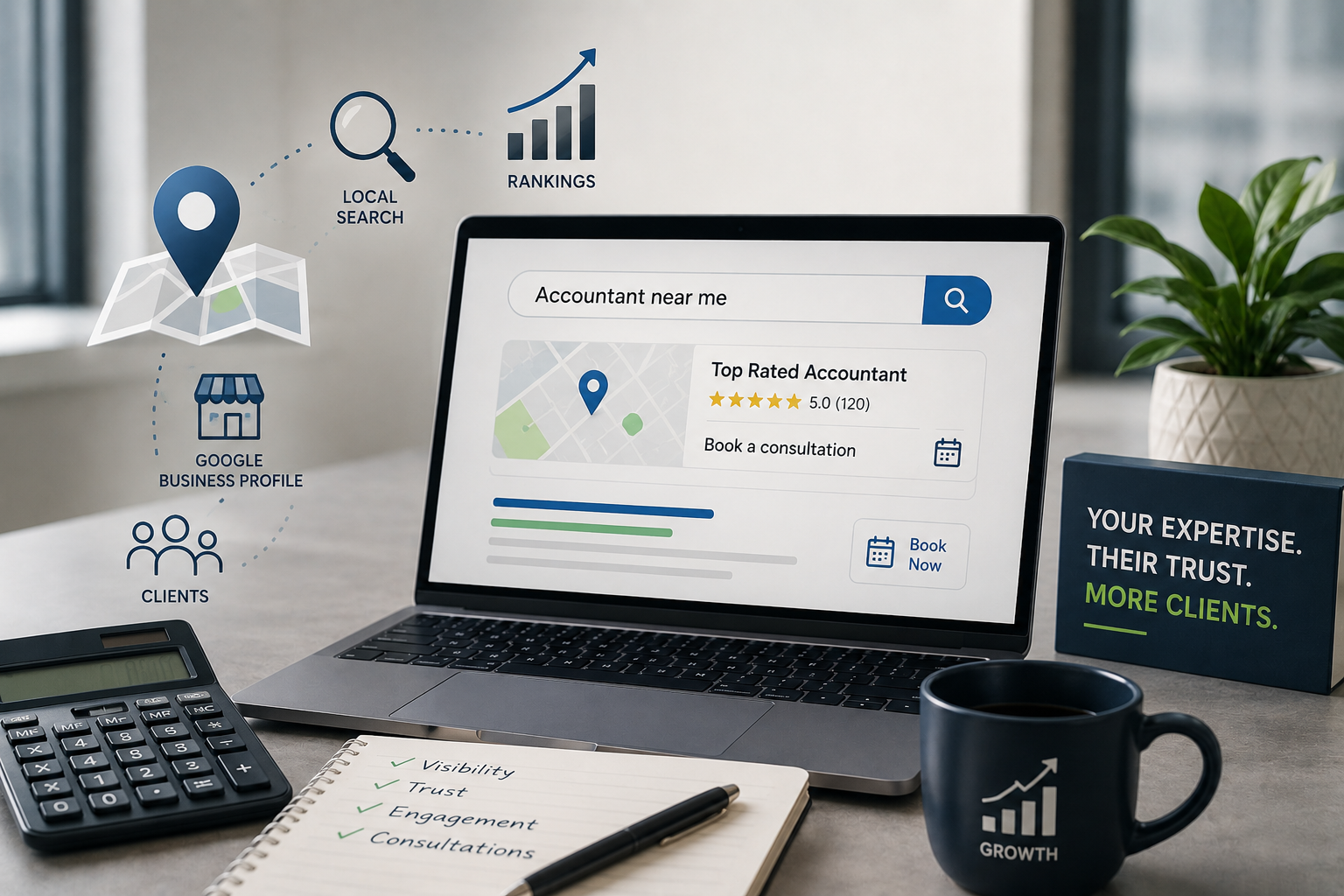
When someone in your area,a sole trader trying to get on top of their accounts, a business owner switching practices, a new limited company looking for their first accountant types “accountant near me” into Google this afternoon, does your firm appear?
Not somewhere on page two. Not buried beneath three directory listings and a comparison site. At the top, where the enquiries actually come from.
For most accountancy practices across the UK, the honest answer is no. Not because their service is inferior. Not because they lack the experience. But because they have built their client base on referrals, which is a perfectly sound strategy until it isn’t and never built the digital foundation that captures the clients who are not being referred.
This post is about closing that gap. Specifically: what it takes to win local accountancy searches consistently, how to turn the visitors who find you into people who actually book a consultation, and why a year-round digital strategy matters far more than a January rush.
Why Most Accountancy Websites Are Losing Enquiries They Should Be Winning
Referrals are wonderful. They arrive pre-qualified, pre-trusted, and with lower resistance to fees. Almost every successful accountancy practice in the UK has been built substantially on word of mouth and there is nothing wrong with that.
The problem is the ceiling.
A referral-dependent practice grows until it runs out of people to refer it. Partners and directors have finite networks. Existing clients refer when they happen to think of it, to people who happen to need an accountant at that moment. The flow is unpredictable, unscalable, and entirely outside the practice’s control.
Digital changes that equation. According to research by Hinge Marketing, more than 70% of professional services buyers conduct online research before making a buying decision even when they have received a personal recommendation. They are checking your website, reading your Google reviews, and forming a judgment about your practice before they ever pick up the phone.
If what they find does not match the confidence of the referral, the enquiry stalls. And if they find nothing at all because your practice does not appear in local search the referral goes to whoever does.
The practices that are consistently winning new business online are not spending enormous sums on digital advertising. They have built the right foundations: a website that earns trust and converts, a local SEO presence that makes them findable for the searches that matter, and a content strategy that captures potential clients between tax seasons. The gap between those practices and the ones that rely entirely on referrals is widening and it compounds with every passing month.
The Seasonality Problem [And Why Year-Round Digital Strategy Solves It]
Let’s address the pattern most accountancy practices recognise immediately.
January arrives. Self-assessment deadlines loom. The phone rings, the inbox fills, the team works flat out. February comes, the deadline passes, and the enquiry flow drops off sharply. The summer is quieter. The autumn picks up a little. And then the cycle repeats.
This is partly an industry reality. But it is also partly a digital problem specifically, the consequence of a digital presence that is either absent or only active when the practice remembers to update it.
The searches that generate year-round enquiries for accountancy firms are not “self-assessment tax return.” They are:
- “accountant for small business [location]”
- “bookkeeping services [location]”
- “VAT return accountant near me”
- “payroll services for small business UK”
- “management accounts [location]”
- “accountant for contractor [location]”
- “how to set up as a sole trader UK”
These searches happen every month, from people starting businesses, changing accountants, expanding their operations, or trying to understand their obligations for the first time. A practice that ranks consistently for five or six of these terms across its local area is generating a steady, predictable stream of new enquiries that has nothing to do with the January deadline.
There is a particularly significant opportunity right now around Making Tax Digital. HMRC’s phased rollout of MTD for Income Tax is bringing hundreds of thousands of sole traders and landlords into a new digital reporting regime that many of them do not yet understand. The search volume around MTD-related queries is growing substantially and the accountancy practices publishing clear, helpful content on what it means and how to comply are capturing that traffic and converting those readers into long-term clients.
A year-round digital strategy does not just smooth enquiry flow. It positions your practice as the authority in your area on the topics your prospective clients are actively researching.
The Five Digital Foundations Every Accountancy Firm Needs
The practices that generate consistent, year-round enquiries online have five things in common. None of them require a large budget. All of them require intention and consistency.
1. Local SEO That Wins the Searches That Matter
“Accountant near me” is searched thousands of times every month across the UK. The practices that appear at the top of those results are winning a disproportionate share of new client enquiries. Getting there requires a structured approach to local SEO the set of tactics that tell Google exactly who you are, where you operate, and why you deserve to appear above your competitors for local searches.
The foundation is your Google Business Profile. If your profile is unclaimed, incomplete, or last updated years ago, you are invisible in the local map pack — the three results that appear above the organic listings for most local searches, and which attract the majority of clicks.
A fully optimised Google Business Profile for an accountancy firm means:
- The correct primary category “Accountant” with additional relevant categories selected (Bookkeeping Service, Tax Preparation Service, Financial Consultant)
- Accurate service areas that reflect where your clients actually come from
- A complete business description that includes your key services and location naturally
- Regular posts timed around relevant dates self-assessment deadlines, Making Tax Digital milestones, VAT return deadlines, year-end planning reminders
- A genuine review strategy that makes it easy for satisfied clients to leave a Google review even a simple follow-up email after a successful engagement, with a direct link to your review page, will build reviews far faster than hoping clients think to do it themselves
Beyond Google Business Profile, citation consistency matters. Your practice’s name, address, and phone number should be identical across every platform where it appears. The ICAEW’s directory and ACCA’s Find an Accountant tool are not just professional listings, they are authoritative citations that improve both your traditional search visibility and, increasingly, your likelihood of appearing in AI-generated search answers. Other useful citation sources include AccountingWeb, local business directories, and your local Chamber of Commerce listing.
If your practice serves multiple towns or districts,common for East Midlands practices covering Nottingham, Derby, Leicester, and surrounding areas each location deserves a dedicated page on your website with specific local content and search terms used naturally throughout.
2. A Website That Converts Visitors Into Consultation Bookings
Traffic without conversion is just noise. The most common failure mode we see with accountancy websites is not poor design, it is passive design. The website describes the practice, lists the services, and then waits for the visitor to do the work of convincing themselves to make contact.
A website that converts does the convincing for them.
The CTA has to be impossible to miss. A “Book a Free Consultation” button or “Get a Free Quote,” or “Call Us Today” should be visible above the fold on every page, on every device. Not in the footer. Not in the navigation menu only. Prominent, clear, and repeating throughout each page so the moment a visitor is ready to act, the action is immediately available.
Service pages need to speak to the client’s problem first. Most accountancy service pages start with a description of the service. The most effective ones start with the problem the client is experiencing “Running a limited company means dealing with corporation tax, payroll, VAT, and Companies House filings. Most directors find that keeping on top of it alone is expensive, stressful, and full of risk” before explaining how the practice solves it. This mirrors the way prospective clients are thinking when they land on the page, and it converts significantly better.
Pricing transparency builds trust faster than anything else. Research from Hinge Marketing consistently shows that professional services firms that display indicative pricing on their websites convert visitors at a higher rate than those that hide it behind “contact us for a quote.” This does not mean you need to publish a full fee schedule. A starting-from price, a description of how fees are calculated, or a pricing tier table for standard services gives prospective clients enough information to qualify themselves — and significantly reduces the friction of making first contact.
Team pages with real photographs matter more than most practices realise. People hire accountants they trust. Trust begins with a face. A team page with professional photographs, brief personal bios, and relevant qualifications communicates humanity and credibility in a way that no amount of corporate language can replicate.
Accreditation logos earn trust silently. ICAEW, ACCA, AAT chartered status, Xero Platinum Partner, QuickBooks ProAdvisor displayed prominently on the homepage and service pages, these logos communicate legitimacy to a prospective client who may not know enough about accounting qualifications to evaluate them but understands that official-looking logos from recognised bodies mean the practice is the real thing.
Finally, your website must load quickly and function correctly on a smartphone. Google’s Core Web Vitals are a confirmed ranking factor, and the majority of local service searches including accountancy searches happen on mobile. A page that takes four seconds to load on a phone is losing clients before they read a single word.
3. Service Pages Built for Search, Not Just Navigation
The typical accountancy website service page is a paragraph or two describing what the service is, written primarily for someone who already knows they want it. This is not sufficient to rank in competitive local search, and it is not sufficient to convert a visitor who is still in the research phase.
A service page that both ranks and converts looks meaningfully different:
- A specific, keyword-targeted H1 “Self-Assessment Tax Returns for Sole Traders in Nottingham” rather than “Self-Assessment”
- 600 to 1,000 words of genuinely useful content explaining what the service involves, who it is designed for, what the process looks like from the client’s perspective, and what it typically costs
- An FAQ section addressing the questions prospective clients actually ask “What information do I need to provide?”, “How long does it take?”, “What happens if I’ve missed a deadline?”
- A clear CTA, book a call, request a quote, download a guide, at the top and bottom of the page
- Internal links to related service pages and relevant blog content
The pages worth building first are those targeting the highest-value, most searched services: self-assessment tax returns, VAT returns, limited company accounts, payroll, bookkeeping, and right now Making Tax Digital compliance. Each of these deserves its own dedicated page, not a section on a single “Services” page that Google cannot rank for anything specific.
The Sage blog is a useful reference for the kind of content that performs well in this space detailed, jargon-free, genuinely helpful explanations of accountancy topics that prospective clients are searching for. The difference is that when Synergi builds these pages for your practice, they are ranking for local searches that drive enquiries to you, not to a software company.
4. A Content Strategy That Builds Authority Between Tax Seasons
Accountancy practices are uniquely well-placed to produce content that ranks and converts, because they possess exactly the expertise that their prospective clients are searching for answers to and most of them are not publishing it.
The questions that prospective clients search every month, regardless of season:
- “What expenses can I claim as a sole trader?”
- “Do I need to register for VAT?”
- “What is Making Tax Digital and how does it affect me?”
- “How much does an accountant cost for a small business?”
- “When do I need to file my corporation tax return?”
- “What’s the difference between a sole trader and a limited company?”
Each of these is a search that someone types when they are trying to understand their obligations and, in many cases, beginning to realise that they need professional help. A practice that publishes a well-written, genuinely helpful answer to each of these questions hosted on its own website, with a natural CTA to book a consultation is capturing that traffic and converting those readers into clients.
The compounding effect is significant. A guide published this month builds domain authority and generates enquiries for years. AccountingWeb is the UK’s most authoritative accountancy publication practices that contribute guest content or are mentioned on the platform gain authoritative backlinks that strengthen the entire website’s search visibility.
5. Enquiry Handling That Does Not Lose Warm Leads
Everything above the local SEO, the website, the content, the service pages exists to generate enquiries. This final piece determines whether those enquiries convert into clients.
The Harvard Business Review research cited in our guide to digital presence for professional service firms is unambiguous: businesses that respond to web enquiries within an hour are nearly seven times more likely to have a meaningful conversation with a decision-maker than those that wait longer. For a prospective accounting client who has filled in three contact forms simultaneously, the practice that responds first almost always wins the instruction.
The practical solutions are straightforward:
Automated acknowledgement on every form submission. An immediate, personalised email confirming receipt of the enquiry and setting an expectation for when they will hear back costs nothing to set up and dramatically reduces the drop-off between enquiry and consultation booking.
Calendar integration on your website. Tools like Calendly or Acuity allow prospective clients to self-book a consultation at a time that suits them, without waiting for a reply. This removes the back-and-forth friction from the process entirely — and means enquiries received at 10pm on a Sunday convert into booked consultations before the team arrives on Monday morning.
A shared inbox or basic CRM. Enquiries that land in a personal email address, or in a shared inbox that nobody owns, get missed. A simple shared inbox system — even a Google Workspace shared mailbox — ensures every enquiry is visible to the right person and followed up appropriately.
These are not complex systems. But they require a deliberate decision to treat enquiry handling with the same seriousness as enquiry generation — and the practices that have made that decision are consistently outperforming those that haven’t.
What AI Search Means for Accountancy Firms in 2026
When someone asks ChatGPT “do I need an accountant for my limited company?” or Google surfaces an AI Overview for “best accountants for small businesses Nottingham,” the firms that appear in those answers are not chosen at random.
AI search tools including Google’s AI Overviews, ChatGPT, and Microsoft Copilot synthesise answers from content that is structured to answer specific questions clearly, from organisations that are listed on authoritative third-party sources, and from websites that use structured data to help machines understand their content.
For accountancy firms, the practical actions that improve AI search visibility are:
FAQ content built around real client questions. The MTD questions, the VAT threshold questions, the sole trader vs limited company questions, all structured as clear, concise FAQ content on dedicated pages or within service pages. AI models are trained to answer questions, and content that mirrors that format is significantly more likely to be cited.
Full, accurate listings on ICAEW and ACCA directories. These are among the most authoritative sources AI models reference when answering accountancy questions. A practice that is listed, correctly categorised, and linked from these platforms is more likely to be surfaced in AI-generated answers than one that is not.
Schema markup. Adding AccountingService schema to your website along with FAQPage schema on pages with FAQ sections tells search engines and AI tools exactly what your practice does, where it operates, and how to contact you, in a machine-readable format that significantly improves citation accuracy.
Mentions on authoritative publications. Guest articles, expert quotes, or practice profiles on AccountingWeb and relevant local business press build the citation profile that AI models use to understand which practices are credible authorities on accountancy topics.
The majority of UK accountancy practices have not yet optimised for AI search. The window for early-mover advantage is open — but it is closing.
Common Digital Mistakes Accountancy Firms Make
The patterns are consistent across the practices we audit. Every one of these is fixable and none requires a significant budget.
A homepage that talks about the firm rather than the client’s problems. “We are a Nottingham-based accountancy practice with over 20 years of experience” tells a prospective client very little about whether you can solve their specific problem. A homepage that opens with the client’s situation “Running your accounts alongside running your business is exhausting. We take it off your plate.” —converts significantly better.
Service pages too thin to rank. A 100-word description of “bookkeeping services” is not a page Google will rank for “bookkeeping services Nottingham.” It is a navigation element. Every core service needs its own substantive page.
No Google Business Profile, or one that has not been maintained. Outdated opening hours, the wrong phone number, no recent posts, no responses to reviews each of these reduces your local search visibility and sends a signal to prospective clients that the practice may not be actively managed.
No review strategy. Referral-dependent practices often have excellent client relationships and almost no Google reviews, because satisfied clients are never prompted to leave one. A simple, consistent process for requesting reviews after successful engagements a follow-up email with a direct review link transforms this within months.
Ignoring Making Tax Digital as a content opportunity. The ongoing MTD rollout is generating sustained search traffic from sole traders and landlords who need to understand their obligations. Practices not publishing content on this topic are leaving significant organic traffic and new client enquiries on the table.
No automated enquiry acknowledgement. A prospective client who submits a contact form and hears nothing for 24 hours has almost certainly already booked with a competitor. An automated acknowledgement costs minutes to set up and prevents this loss entirely.
What This Looks Like Alongside Our Other Industry Work
The digital foundations in this guide local SEO, conversion-optimised web design, content authority, AI search visibility apply across every professional services sector we work in. If you work alongside firms in related fields or want to understand how the strategy differs by industry, these guides cover the specifics:
- How professional service firms build a digital presence that actually wins clients → — the full strategic framework this post sits within
- Digital marketing for solicitors → — how law firms get found before comparison sites intercept their enquiries
- Digital marketing for charities → — how non-profits compete for visibility and donations without a commercial budget
- Digital marketing for estate agents → — how agencies dominate local property searches and stand out from the portals
Ready to See What’s Holding Your Practice Back Online?
Most accountancy practices that come to us for a digital audit already know something is not working — they just are not sure which part to fix first.
That is exactly what our free SEO audit answers. We review your website, your local search visibility, your Google Business Profile, your content, and your enquiry handling — and give you a clear, prioritised picture of where you are losing potential clients and what it would take to fix it.
No templates. No automated reports. No jargon. A real review by a real team, with specific recommendations for your practice.
Or call us directly on +44 115 860 2050 — Monday to Friday, 9am to 5:30pm.
Frequently Asked Questions
How long does it take for SEO to generate new enquiries for an accountancy practice?
Local SEO improvements, particularly Google Business Profile optimisation, review building, and citation consistency often show measurable results within six to eight weeks. Broader organic search improvements from content and service page optimisation typically build over three to six months, compounding significantly from month four onwards. We set realistic timelines from the start and report on progress monthly.
Do I need to redesign my website to improve my digital performance?
Not always. Many of the most impactful improvements adding FAQ content, improving page speed, building out thin service pages, optimising your Google Business Profile can be made without a full redesign. Our audit will tell you honestly whether a redesign is necessary or whether targeted changes will deliver the results you need.
What is Making Tax Digital and why does it matter for our digital strategy?
Making Tax Digital is HMRC’s programme to digitalise income tax reporting for sole traders and landlords. The phased rollout is creating a sustained wave of people actively searching for accountancy support and guidance on their new obligations. Practices that publish clear, helpful content on MTD are capturing this traffic and converting those readers into long-term clients it is one of the most significant content opportunities in the accountancy sector right now.
How important are Google reviews for a small accountancy practice?
Extremely important. Google reviews are one of the primary signals Google uses to rank businesses in local search results the map pack that appears at the top of most local service searches. A practice with 30 genuine reviews and a 4.8-star rating will consistently outrank a more experienced practice with 3 reviews and a 4.2 rating. Building reviews is one of the highest-leverage, lowest-cost things a practice can do to improve its local search visibility.
What is GEO and should accountancy practices care about it yet?
Generative Engine Optimisation (GEO) refers to optimising your digital presence to appear in AI-generated search answers the summaries produced by ChatGPT, Google’s AI Overviews, and similar tools. It is an emerging discipline, but the practices that invest in it now through FAQ content, authoritative directory listings, and structured data are establishing a visibility advantage that will be significantly harder to close in two to three years. We recommend building GEO into your strategy from the start rather than retrofitting it later.
Is this only relevant for practices near Nottingham? We are based in Nottingham and work with accountancy practices across the East Midlands and throughout the UK. Every strategy is tailored to your specific geographic market whether you are targeting clients in Nottingham city centre, across Nottinghamshire, or in a different region entirely.